



A Housing Market Under Pressure
Sociologist and researcher Dr. Stephen Sills describes the current market as a kind of gridlock. There are not enough places for people to move into, and not enough places for people to move up from. For households with the lowest incomes, the challenge is especially severe.
Forsyth County needs roughly 25,000 additional housing units by 2030 to meet projected demand. Within that larger need is an estimated 8,100-unit deficit for renters who need housing affordable at or below 30% of area median income. More than 43,000 households in Forsyth County are cost-burdened, meaning they spend more than 30% of their income on housing and related expenses. Eviction filings have also returned to troubling levels, with more than 10,500 filed in the county last year.
Sills said the shortage creates a ripple effect across the housing market. When higher-income households compete for lower-cost units, it puts pressure on every level. “We need more housing across all segments of the market.”

For families, the numbers show up in everyday tradeoffs. A household may move farther from work to find lower rent, only to spend more on transportation. A parent may delay repairs to keep up with rising costs. A renter may face displacement after falling behind by less than a month’s rent. A young adult may be ready to live independently but find there is no affordable place to go.
Sills emphasized that eviction is often not the result of a large debt, but of a small financial disruption with long-lasting consequences.
“We know that in most cases it’s less than $1,000 – a month or two worth of back rent – that is displacing individuals and leading to homelessness and other negative outcomes,” he said.
Building More—and Building Differently
Forsyth County’s housing needs cannot be met by repeating the same development patterns of the past. Much of the county’s housing stock is single-family housing, a pattern shaped by decades of land-use decisions, zoning practices, lending systems, and development norms.
Single-family homes will continue to be part of the solution, but they cannot be the only solution. Today’s needs call for a broader range of housing options: duplexes, quadplexes, accessory dwelling units, townhomes, apartments, community land trust models, and other forms of gentle density that can fit into existing neighborhoods.
Gentle density does not mean changing the character of neighborhoods overnight. It means creating more opportunities for people to live near jobs, schools, parks, transit, and community assets. It means making room for older adults, young professionals, working families, and people with lower incomes to find homes in the communities where they already have connections.
Sills pointed to neighborhoods such as Ardmore and West End as examples of places where different housing types already exist side by side.
“You can do a blend to create walkable and livable neighborhoods,” he said. “Yet, new housing often meets resistance.” Concerns about property values, traffic, schools, and crime can slow or stop projects, even when research and local experience show that well-designed affordable housing can strengthen neighborhoods rather than diminish them.
Listening to Residents Closest to the Issues
Data helps define the scale of the challenge. But residents help define what solutions must look like.
Through Partnership for Prosperity’s Moving Families Forward initiative, neighborhoods including Salem Gardens, Eastgate, and Castle Heights are identifying priorities and shaping solutions from within. Arleatha Patterson, Executive Director with Partnership for Prosperity, describes the work as deeply resident-led.
“Most organizations try to tell the community what they need,” Patterson said. “Partnership for Prosperity takes a holistic approach by looking at the gifts, skills, and talents of the community and building solutions from what’s already there.”
Housing consistently rises to the top as a priority, but each neighborhood’s experience is different.
- In Salem Gardens, residents have raised concerns about habitability, mold, water damage, maintenance issues, and evictions.
- In Castle Heights, where many residents are homeowners, the conversation has included home repairs, wealth preservation, youth employment, and neighborhood leadership.
- In Eastgate, early engagement has highlighted the importance of understanding residents’ distinct experiences, including older adults, veterans, and people navigating health or reentry barriers.
.png)
For Patterson, the work begins with listening differently. “We use the social determinants model that centers the voice and lived experiences of the community,” she said.
That approach reveals both the barriers residents face and the assets that are already present. In Salem Gardens, for example, residents identified not only housing concerns, but also a community center that was underused, neighbors with leadership skills, and opportunities to bring partners together around food access, technology, education, and advocacy.
“When we did a community survey, we realized all of the gifts, skills, and talents that were previously overlooked,” Patterson said. “We started to focus on the assets that that community already had.”
Housing Stability Is Connected to Everything Else
Housing instability rarely exists in isolation. It intersects with transportation, employment, education, food access, health, legal systems, and civic participation.
Moving Families Forward has helped residents address these interconnected barriers in practical ways. Patterson shared that a driver’s license restoration effort helped more than 25 residents regain their licenses. For those residents, restoring a license can affect their ability to get to work, take children to school, and maintain housing stability.

Residents have also organized around food access, helping distribute about 500 pounds of food per month in Salem Gardens. A new computer lab in the community center created access to technology and digital literacy opportunities. Study circles have connected residents with service providers and helped shape solutions around education, employment, and housing rights.
In Patterson’s words, the power of the approach is that residents are eager to solve problems that impact their neighborhoods. That civic muscle matters. Residents have organized tenant association meetings, attended City Hall, filed complaints, and spoken publicly about their experiences. They are not only naming what is wrong; they are helping define what should come next.
A Continuum of Solutions
Forsyth County’s housing challenge requires a continuum of solutions that meet people wherever they are: from urgent shelter and eviction prevention to long-term affordability, home repair, and ownership opportunities.
Sills described three broad categories of action: prevention, preservation, and production.
- Prevention means keeping people housed through eviction mediation, legal support, tenant education, emergency assistance, and systems navigation.
- Preservation means protecting and repairing existing affordable housing, supporting older homeowners, improving weatherization, and preventing naturally occurring affordable housing from being lost to speculation or neglect.
- Production means creating new housing across the affordability spectrum, including deeply affordable rental units, infill development, gentle density, and shared-equity models.
.png)
“If we prevent people from being displaced on the front end and keep them housed, that’s great,” Sills said. “Then we can work to preserve affordable housing stock that already exists and ultimately produce more creative housing to fill our long-term density needs.”
This work also requires flexible capital and new financing tools. Deeply affordable housing often cannot be built or preserved without public, private, and philanthropic investment. Smaller-scale and emerging developers also need access to working capital and financing that can help them contribute to the local housing ecosystem.
Local impact investing, housing trust funds, revolving loan funds, public incentives, land-use reform, and community-led development all have a role to play. Also important are trusting relationships among residents, nonprofits, government, lenders, developers, and philanthropy.
A Shared Responsibility
Forsyth County’s housing needs are significant, but the community is not starting from scratch. We have data that clarifies the scale of the challenge. We have residents who are organizing, speaking up, and shaping solutions. We have partners working across systems to prevent displacement, preserve homes, and produce new housing. And we have growing momentum around the belief that housing is not just a private market issue, but a shared community responsibility.

When families can find safe, stable, and affordable housing, children have a stronger foundation for learning. Workers can live closer to their jobs. Older adults can remain in the neighborhoods they helped build. Residents can participate more fully in civic life. Communities can grow without leaving people behind.
Forsyth County’s housing challenge is urgent. It is also an opportunity: to listen more deeply, invest more strategically, and build a future where every neighbor has access to a home that supports dignity, stability, and opportunity.
TAKE MEANINGUL ACTION WITH US:
- Get connected to the Humane Housing Network to join a working group and help implement the Humane Housing Network Action Planning Framework.
- Learn how to partner with The Winston-Salem Foundation to expand access to housing across Forsyth County.
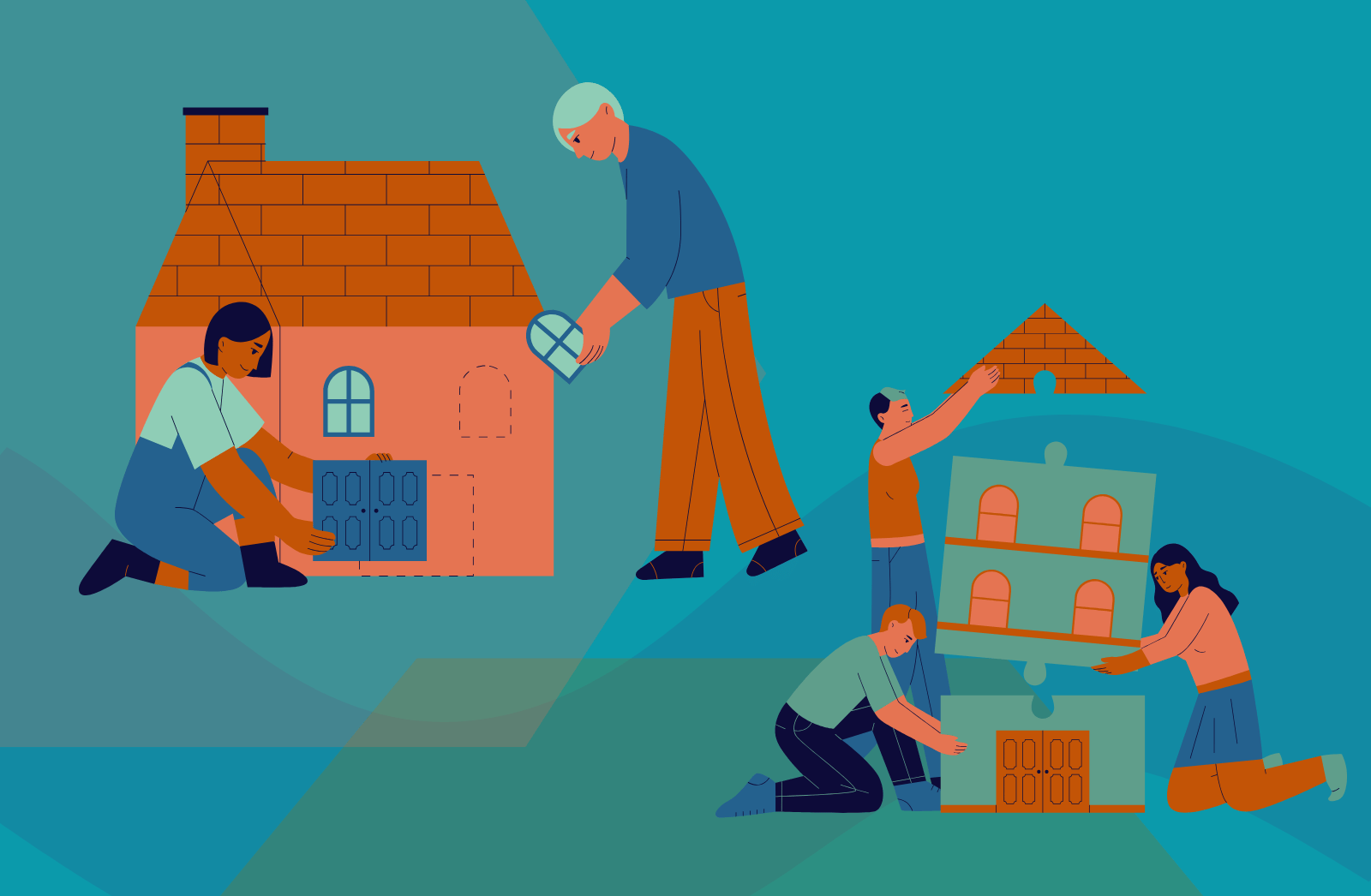
Illustrations created by Camille Ramos.




.png)
%20feature%20image.png)
.png)
.png)